
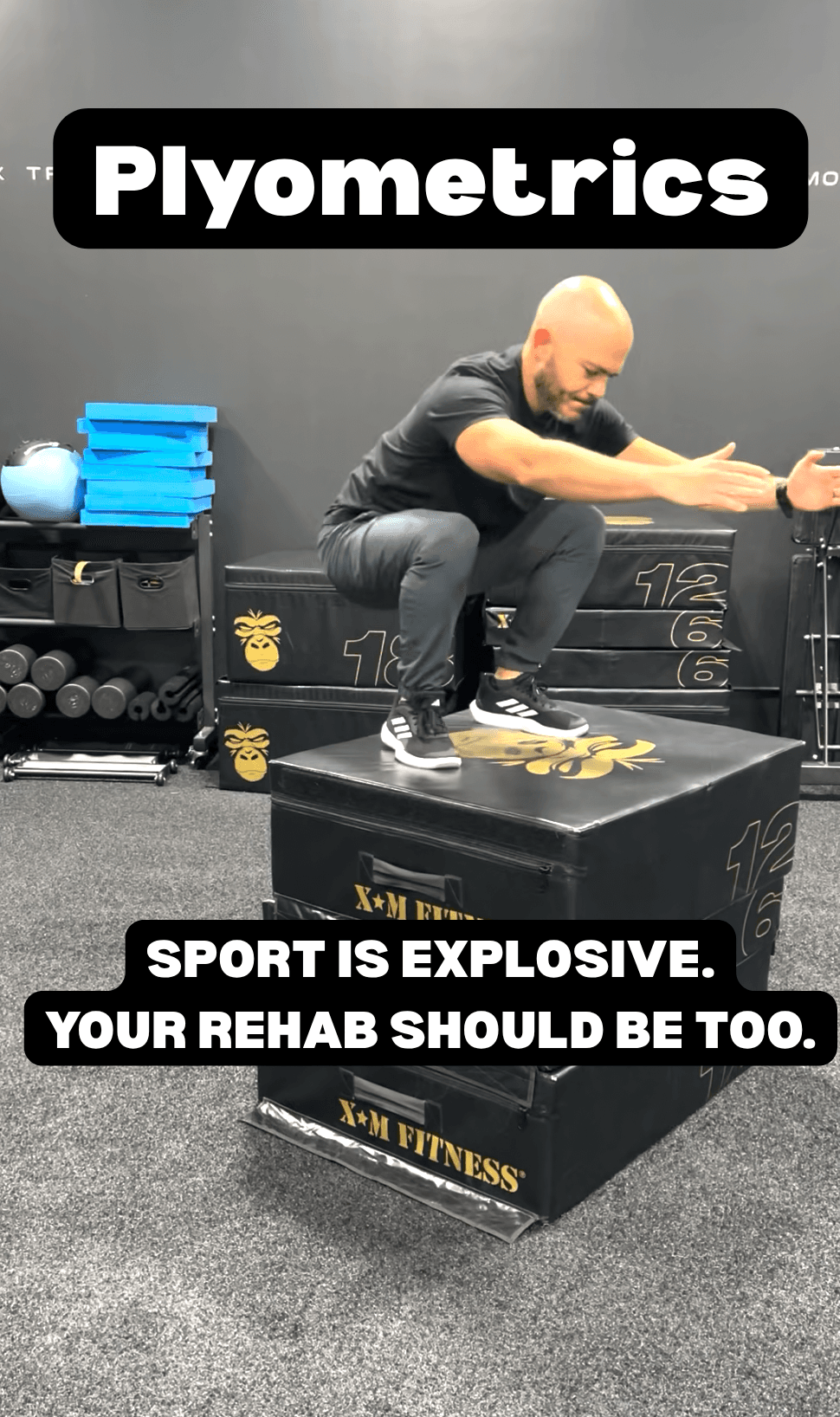
Sport Is Explosive. Your Rehab Should Be Too.
When recovering from an injury, it’s easy to think of rehab as simply getting stronger.
Strength is important, but it’s only one piece of the puzzle.
If your goal is to return to soccer, running, basketball, skiing, or another sport, eventually your rehab needs to prepare you for the speed, force, and unpredictability of that sport.
That’s where plyometrics come in.
What are plyometrics?
Plyometric exercises involve rapidly producing and absorbing force. Jumping, hopping, landing, and bounding are all examples.
They train your body to:
- Absorb force efficiently
- Produce force quickly
- Transition between loading and pushing off
- Control your body during dynamic movements
- Improve explosiveness and reactive strength
These qualities are important in almost every sport.
Think about sprinting for a loose soccer ball, changing direction, jumping for a rebound, landing from a jump, or pushing off your foot to accelerate. These movements happen quickly and require much more than simply having strong muscles.
Plyometrics are a progression
You don't have to start with the most difficult jump possible.
In fact, a good plyometric program should usually progress from simple movements with an emphasis on control toward faster, more powerful, and more sport-specific movements.
For example:
1. Snap Downs
A great starting point for learning how to absorb force and control your landing.
You’re essentially teaching your body how to quickly move into a strong, controlled position.
2. Box Drops
Now we're introducing a little more landing force while continuing to emphasize control and positioning.
3. Pogos
Pogos introduce repeated, rapid contacts with the ground.
They challenge your ability to produce and absorb force quickly and develop the stiffness and elasticity needed for running and jumping.
4. Single-Leg Lateral Hops
Now we introduce single-leg and lateral movement.
This is particularly relevant to sports where you're constantly moving side-to-side, changing direction, and pushing off one leg.
5. Single-Leg Plate Hops
These increase the demand on single-leg control and reactive strength while adding a coordination challenge.
6. Broad Jumps
Broad jumps shift the focus toward producing force horizontally.
This has obvious applications to acceleration and forward propulsion.
7. Box Jumps
Now we're asking for more explosive force production while controlling the landing onto an elevated surface.
8. Bulgarian Split Squat Jumps
These add a unilateral component while challenging power, coordination, and the ability to produce force through a split stance.
9. Depth to Box Jumps
This combines a rapid landing with an immediate explosive movement.
You're now asking the body to absorb force and quickly produce it again , a quality that is highly relevant to athletic performance.
Click here to see these exercises in action
Why does this matter for injury rehabilitation?
One of the biggest mistakes in rehabilitation is assuming that someone is ready to return to sport simply because they are pain-free or strong enough to perform basic exercises.
Sport places different demands on the body.
You don't play soccer by slowly performing controlled squats. You sprint, stop, accelerate, jump, land, cut, and react.
Your rehabilitation should gradually expose you to those demands before you return to full competition.
That doesn't mean everyone needs to perform advanced plyometrics immediately after an injury.
It means that plyometrics can be progressed according to the person's injury, strength, training history, goals, and stage of rehabilitation.
The exercise itself isn't necessarily the goal.
The goal is to build the capacity required to do what you want to do.
Performance and rehabilitation aren't opposites
Plyometrics aren't exclusively for elite athletes.
They're simply another tool we can use to develop physical qualities that matter for everyday movement and sport.
Someone returning to soccer after a knee injury may eventually need to tolerate repeated single-leg hops and changes of direction.
A runner may need to tolerate thousands of rapid ground contacts.
A recreational athlete returning to skiing may need to repeatedly absorb and redirect force.
The exercises may look different, but the principle is the same:
Progressively prepare the body for the demands you are asking it to meet.
The bottom line
Good rehabilitation doesn't just get you back to where you were before your injury.
It should help you build the strength, control, confidence, and capacity to return to the activities you enjoy.
Sport is explosive. Your rehab should be too.
If you're recovering from an injury and struggling to get back to your sport or activities, a physiotherapy assessment can help determine where you are now and what you need to work toward next.
📍 Calgary | Book a physiotherapy assessment