
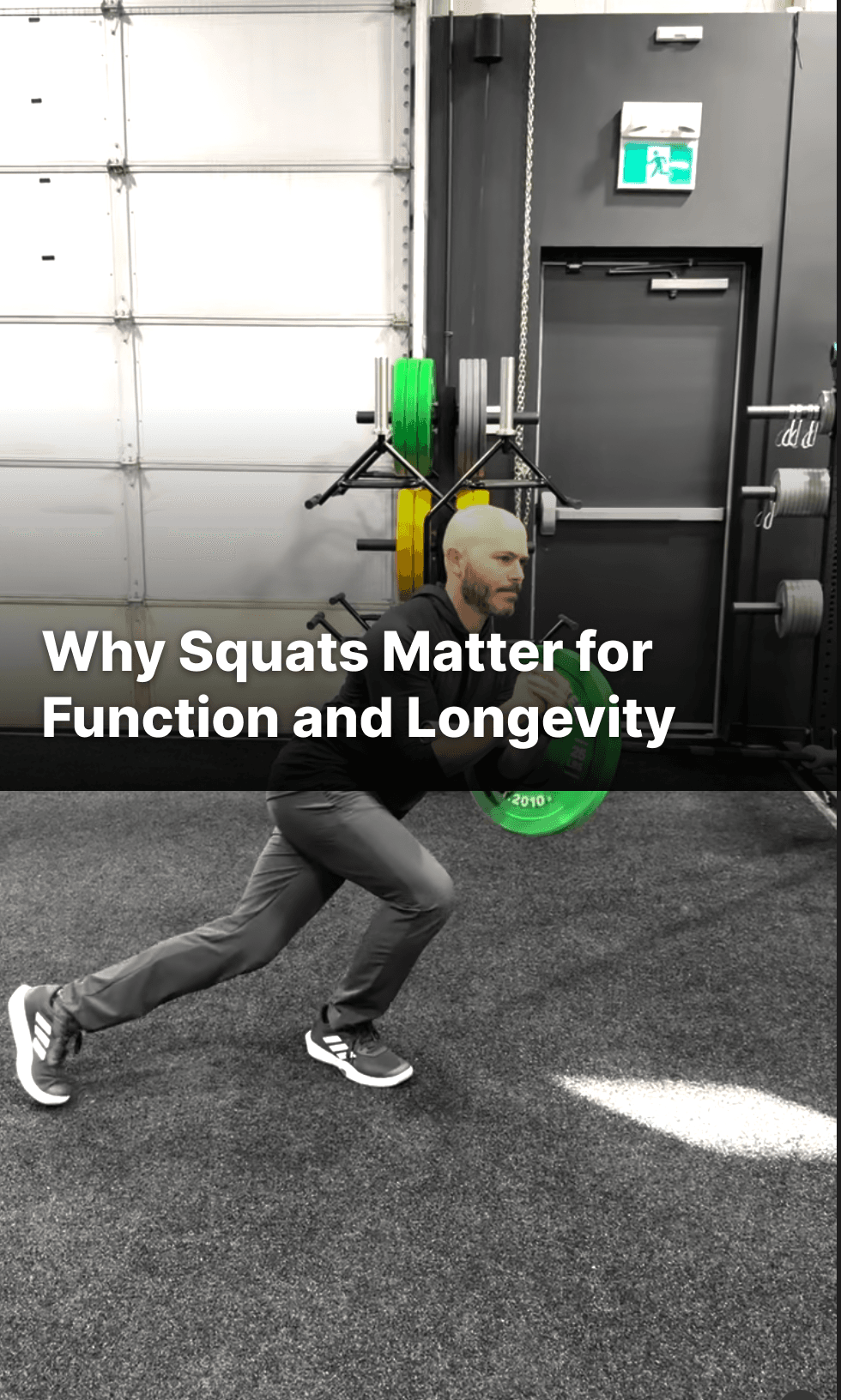
Squats are one of the most practical exercises you can do to maintain strength, mobility, and independence throughout life.
Think about how often you squat throughout the day without even realizing it: getting out of a chair, sitting on the toilet, picking something up from the floor, or climbing stairs. These movements rely on strength from your quadriceps, glutes, and other muscles of the lower body.
As we age, muscle strength tends to decline, which can affect our ability to perform everyday activities. Maintaining strength through resistance training helps preserve physical function and supports independence as we get older.
There is also evidence linking muscle strength with longevity. A systematic review and meta-analysis published in Archives of Physical Medicine and Rehabilitation found that higher knee-extension strength was associated with a lower risk of all-cause mortality. While this doesn't prove that stronger quadriceps directly increase lifespan, it highlights the relationship between muscular strength and long-term health.
Why squats?
Squats train several major muscle groups while building strength for everyday tasks. They can also be adapted to suit different fitness levels and abilities, from sitting down and standing up from a chair to performing weighted squats at the gym.
You don't need to lift heavy weights to get started. Begin with a variation you can perform comfortably and progressively increase the challenge as your strength improves.
The takeaway: Squats are a valuable exercise for building and maintaining lower-body strength, supporting everyday function, and helping you stay active and independent as you age. Include them in a well-rounded strength-training routine alongside exercises for the rest of your body and regular aerobic activity.
References
-
García-Hermoso A, et al. (2018). Muscular Strength as a Predictor of All-Cause Mortality in an Apparently Healthy Population: A Systematic Review and Meta-Analysis of Data From Approximately 2 Million Men and Women. Archives of Physical Medicine and Rehabilitation, 99(10), 2100–2113.e5. https://doi.org/10.1016/j.apmr.2018.01.008
-
World Health Organization. (2020). WHO Guidelines on Physical Activity and Sedentary Behaviour. https://www.who.int/publications/i/item/9789240015128